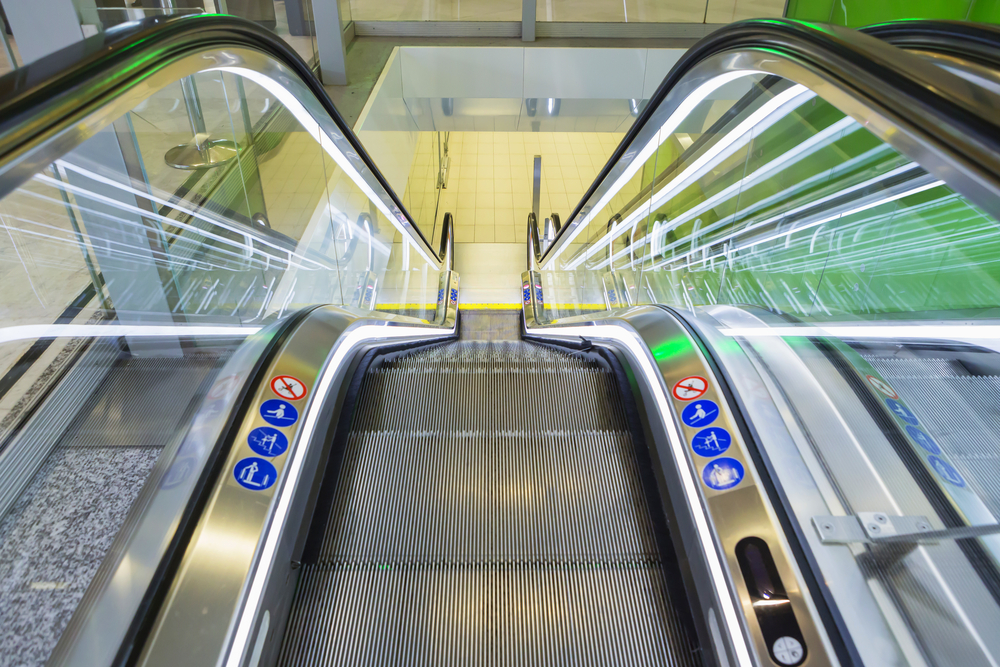
Escalators: The Complete Owner’s Guide
An escalator carries the public, so its owner carries an obligation that never transfers to the maintenance contractor. Specification, maintenance, modernisation and compliance across the whole lifecycle.

- Published

In this article 8 sections
In this article
- An escalator is a public machine, and that changes the obligation
- The four stages of an escalator lifecycle
- Specifying an escalator
- What escalator maintenance actually has to prove
- Escalator modernisation versus replacement
- The escalator compliance obligation that does not transfer
- The escalator questions to settle
- Why escalator decisions belong with independent advice
Quick summary
An escalator is a public machine, and that single fact changes every decision attached to it. It carries people who have not been trained, cannot be supervised and will not read a notice. The escalator owner therefore carries an obligation that does not transfer with the maintenance contract, and it lasts for the life of the installation. This guide covers the four stages of an escalator lifecycle, what to specify at each, and where the obligation actually sits.
An escalator is a public machine, and that changes the obligation#
Most building plant serves people who work in the building. An escalator serves the public.
That distinction carries legal weight. The operator of an escalator is in scope for the safety of everyone who uses it, including people who behave unpredictably, carry more than they can hold, or are not paying attention. The duty is primary and does not transfer to a contractor.
The practical consequence is simple: every escalator decision is made twice, once for performance and once for the evidence you will need later.
The four stages of an escalator lifecycle#
An escalator passes through four stages, and each one is a different decision made by a different party.
Feasibility and specification. Whether the escalator is the right machine at all, and what it has to do. Rise, throughput, environment and the walking distance being replaced. This stage locks the geometry, and the geometry cannot be changed.
Installation and commissioning. The escalator is structurally integrated, which means the truss, the support and the maintenance access are building works rather than equipment. Access for installation is a design decision made years before the escalator arrives.
Operation and maintenance. This is the longest stage and the one most often reduced to a contract. An escalator maintenance arrangement should produce evidence as well as attendance, and those are two different outputs.
Modernisation or replacement. Escalators reach a point where the components are obsolete and the modernisation decision is forced. Planning it early is cheaper than being driven to it.
Specifying an escalator#
The specification stage is where an escalator is won or lost, and four parameters decide most of it.
| Parameter | Why it matters | What locks |
|---|---|---|
| Rise and incline | Sets the geometry and the machine type | The structural opening |
| Throughput | Sets the step width and the duty grade | The machine size |
| Environment | Indoor, outdoor, semi-exposed | The specification level and the finishes |
| Maintenance access | How the escalator is serviced | The building layout around it |
The escalator specification and the building design are one exercise. When they are separated, the escalator arrives into an opening that does not suit it, and everything downstream is a variation.
What escalator maintenance actually has to prove#
An escalator maintenance program has two outputs, and most contracts only buy one.
The first output is attendance. A technician arrives, works on the machine and leaves. That keeps the escalator running.
The second output is evidence. A record of what was tested, what was found, what was deferred and when. That is what an operator needs when the question is not whether the escalator works but whether the duty was discharged.
A compliant escalator program produces both. Our escalator safety reports service exists because the second output is routinely missing, and because it is the one that matters after an incident rather than before one.
Escalator modernisation versus replacement#
The escalator modernisation question is usually framed as a cost comparison. It is better framed as a question about the structure.
Where the truss and the support structure are sound, modernisation of the escalator is usually the better answer. The building work is already done, the geometry already works, and the disruption is contained to the machine.
Where the structure is not sound, the comparison changes, because replacement escalators bring the access and the support back into scope.
Our escalator and vertical transportation service covers this assessment as part of a wider brief, and the elevator improvements service follows the same reasoning for vertical equipment.
The escalator compliance obligation that does not transfer#
The most expensive misunderstanding in escalator ownership is the belief that appointing a maintenance contractor transfers the obligation.
It does not. The contractor is engaged to perform work. The obligation to keep the escalator safe remains with the operator, which means the operator is responsible for knowing whether the work was adequate, not merely whether it happened.
That is why escalator compliance is not a paperwork exercise. The NCC 2025 compliance position sets out the broader framework, and it applies to escalators as much as to lifts.
The escalator questions to settle#
- Is an escalator the right machine for the journey being replaced.
- What is the peak throughput, and what duty grade does it require.
- What maintenance access does the building provide, and is it adequate.
- What does the maintenance program produce as evidence, not just as attendance.
- Is the truss sound, because that decides modernisation versus replacement.
- Who is verifying that the obligation is being met, and how often.
Why escalator decisions belong with independent advice#
An escalator is a large, publicly used, structurally integrated machine, and it is specified once.
That makes it the worst possible purchase to make on a single supplier’s advice. The escalator that ages well is the one specified against the building and against the obligation, not the one selected from a range.
This practice has delivered escalator work across shopping centre and transport assets, and the client list includes the operators who run the largest public escalator estates in the country. Our independent lift consulting service covers escalators as one part of a wider transportation brief.
ILCPL provides independent lift, elevator and escalator consulting across Australia, New Zealand and Asia, with no ties to any manufacturer or contractor. Call 0417 784 245.