
Lift and Elevator Consultants in New Zealand
New Zealand is a small market with a long supply chain. Lift plant in Christchurch, Wellington and the smaller centres is supported from offshore, so work that would be routine in Brisbane involves shipping, lead times and a shorter list of bidders. The consenting and ownership framework is also entirely its own, separate from every Australian state. ILCPL has worked in Christchurch, Paraparaumu and Wellington, and works there owner-side, supplying no equipment and holding no maintenance contracts.
- Christchurch, Paraparaumu and Wellington the New Zealand centres in ILCPL's published footprint.
- Owner-side only no equipment supplied, no maintenance contracts held, no manufacturer, supplier or installer affiliation.
- Nearly 50 years continuous consulting to owners, committees and asset managers, across Australia and New Zealand.
- Documented, not asserted condition and maintenance findings recorded so they can be produced later, not read once and forgotten.
Local context
What shapes lift and elevator work in New Zealand?
The market is small. The supply chain is long. The decisions are consequential.
Three things govern the work.
- First, depth of market. A tender in New Zealand will usually attract fewer bidders than the same scope in Australia, and some of those bidders will be representing equipment manufactured offshore. An owner who approaches the market without a specification has very little to compare, because there is no local price bench to test a quote against.
- Second, lead times. Plant, controllers and spares travel. A programme that assumes Australian delivery windows will slip, and slip again at commissioning when the specialist technician is flown in. Timing is a commercial risk on a New Zealand project in a way it often is not across the Tasman.
- Third, the building stock. Christchurch and Wellington both carry commercial and institutional assets where structural assessment sits alongside any lift project, and where the sequence of strengthening, consenting and lift replacement has to be thought through together rather than one after the other. Getting that order wrong costs money twice.
ILCPL works owner-side on all three: lift consultants engaged on an independent basis, a specification written before the market is approached, and a programme that treats shipping and structural work as real constraints rather than footnotes.
Services
Which services are available in New Zealand?
Three lines, delivered from the Queensland base and travelling to the asset. The about ILCPL record behind them covers nearly 50 years of owner-side practice.
Lift consulting
Maintenance contract review, modernisation assessment, whole-of-life capital planning, due diligence and documentation for boards and asset managers. On a New Zealand asset the contract review usually begins with the response commitments and where the servicing technician is dispatched from.
independent lift and elevator consultingElevator consulting
Traffic analysis and vertical transportation planning, shaft and overhead coordination, neutral specifications and tender evaluation. Documentation engagements run through elevator design and specification, with the AS 1735 series as the reference standard used on both sides of the Tasman.
independent elevator adviceEscalator consulting
Safety and condition assessment, maintenance review and modernisation assessment. Detailed reporting sits in escalator condition and safety reporting.
escalator and travelator advice
Getting started
Finding a consultant you can rely on
Most New Zealand engagements come after a quote lands with a lead time nobody can verify.
- One consultant, start to finish. Not a handover between a site visit and the advice.
- Scope agreed before work starts. You know what the engagement covers and what it costs.
- Nothing to sell you. No equipment, no maintenance contract, no supplier line.
- Programmed around the supply chain. Shipping, lead times and commissioning treated as real constraints.
How it works
Service you can rely on
- Send what exists.The contract, recent service reports and any previous report. Nothing is booked until it has been read.
- The plant is inspected.Condition against exposure, not against a schedule, with findings recorded as they are found.
- A written position.What needs doing, what it costs, and how long the supply chain will add to the programme.
The record
Has ILCPL worked on projects in New Zealand?
ILCPL’s published record names three New Zealand centres: Christchurch, Paraparaumu and Wellington. Work has been delivered from the Queensland base rather than through a local office, which is stated plainly because it is the reason the advice carries no local commercial interest.
The record also shows the asset types behind that work: commercial towers, retail, hospital precincts, university campuses, hotels and apartment developments, plus feasibility engagements where the decision was still open. A New Zealand owner is working with a longer supply chain than an Australian one, and the useful question is whether the consultant has priced and programmed around that before. Lift consultants New Zealand owners engage are usually being asked to bridge exactly that gap.
The complete record, covering Australia and New Zealand, sits in the published project lists.
Compliance
What compliance rules apply in New Zealand?
- Regulator
Health and safety on a New Zealand site sits with WorkSafe New Zealand under the Health and Safety at Work Act 2015. Lifts, escalators and moving walkways remain under the control of the building owner, and the obligation to have plant inspected, tested and maintained by a competent person sits with that owner rather than with the service provider alone.
- Approvals and compliance
A lift requires building consent before installation, and a code compliance certificate on completion. Lifts, escalators and travelators are also specified systems, so they are listed on the building's compliance schedule.
- Warrant of fitness
Because the plant is a specified system, the owner must issue and display a building warrant of fitness every 12 months. The territorial authority monitors that regime and can inspect the building and its maintenance records. A lift in a single household unit sits outside it.
- Terminology
The ownership entity for a multi-unit building is a body corporate under New Zealand unit titles legislation, and the consenting authority is the territorial authority. Neither term transfers from an Australian state, and a report written for an owners corporation does not automatically suit a New Zealand body corporate.
- Asset profile
Christchurch and Wellington commercial and institutional stock, much of it subject to structural assessment alongside any lift project, plus retail, health, education and apartment buildings, and a residential market dominated by detached houses.
The New Zealand framework is administered separately, under its own legislation, by its own agencies and local authorities. That is the reason a page written for New Zealand is worth reading rather than a version of the Brisbane page with the place names changed.
Residential
What do home lifts New Zealand owners need to weigh up?
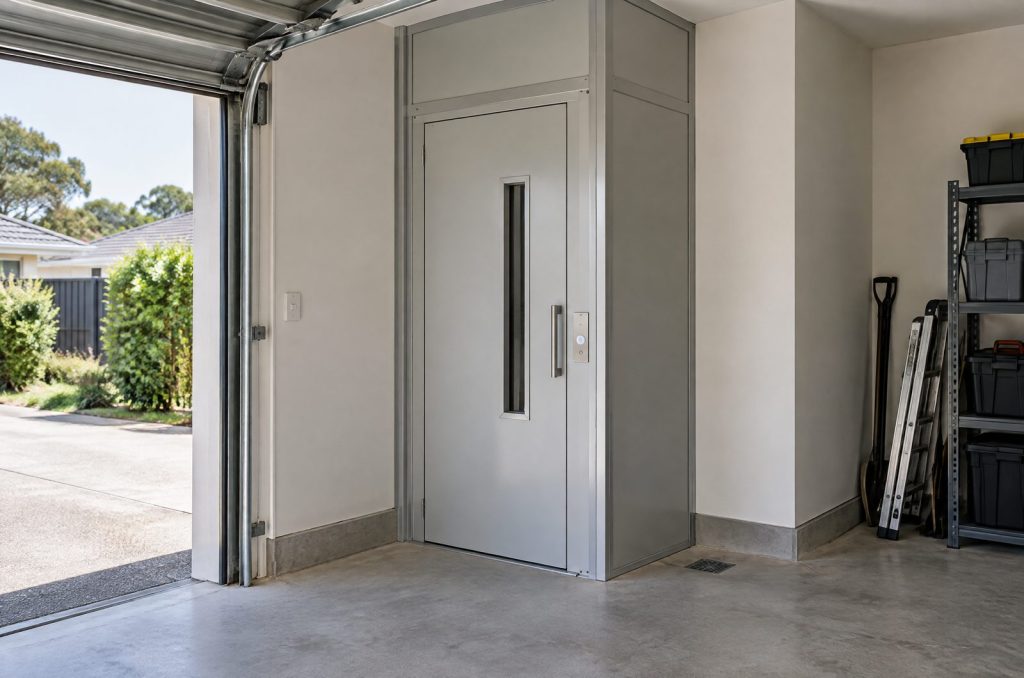
New Zealand’s residential market is dominated by detached housing on its own section, which means home lifts New Zealand owners install are usually retrofits into a standing house rather than units designed in from the start. The structural question comes first: where the shaft can sit, what it can be fixed to, and whether the floor structure was ever intended to carry it.
Site access is the second constraint, and it varies sharply by centre. Hillside sections in Wellington and the surrounding suburbs can leave very little level ground and a narrow route for materials, while flatter centres present the opposite problem, a house with no obvious place to put a shaft without losing a room.
The third is servicing. A smaller market means fewer service technicians and longer parts lead times, so warranty terms, spare parts holding and response commitments carry more weight than they would in Sydney or Melbourne. Step-free access is the objective, and the service agreement is what determines whether it survives. Owners comparing home lifts New Zealand wide should settle those terms before comparing unit prices. For the wider picture, read the home lift guide.
New Zealand questions
Frequently asked questions
7 questions
Does ILCPL have a New Zealand office?
No. ILCPL works from a Queensland base and travels to the asset. That is stated openly on every location page, because what an owner is buying is independence from manufacturers, suppliers and installers, and a local address does not create it.
Which New Zealand centres has ILCPL worked in?
Christchurch, Paraparaumu and Wellington appear on the published project record.
What does a building warrant of fitness mean for a lift owner?
It means the lift sits on the building’s compliance schedule, with defined inspection, maintenance and reporting procedures, and the owner signs and displays a warrant every 12 months confirming those have been met. The obligation belongs to the owner, so the owner carries the consequence if the paperwork does not stand up.
Does the distance from Australia affect an engagement?
It shapes it rather than limiting it. Site attendance is planned around the work that genuinely requires a person on site, document review runs remotely, and the programme is built with travel in the critical path rather than treated as an afterthought.
How does the New Zealand framework differ from the Australian states?
It is administered separately, under its own legislation, by its own agencies and local authorities. Consenting and the ownership structures that govern multi-unit buildings do not carry over from New South Wales, Victoria or Queensland, so the documentation has to be written for the
jurisdiction the asset sits in.
Can ILCPL review a maintenance contract held on a New Zealand asset?
Yes. Contract review is one of the more common engagements, and on a New Zealand asset it usually turns on response commitments, spare parts holding and where the servicing technician is dispatched from, because those are the terms that cost an owner money when they fail.
Is ILCPL tied to any manufacturer or installer operating in New Zealand?
No. No equipment is supplied and no maintenance contract is held, in New Zealand or anywhere else. Specifications are manufacturer-neutral and tenders are evaluated against the terms the owner set.
Areas we cover
Other areas
Each page is written for the jurisdiction it sits in, because the framework changes at every border.
- QLD
Brisbane
The deepest project history in the practice, across towers, retail, hospitals and universities.
Brisbane lift and elevator consultants - NSW
Sydney
A deep stock of ageing commercial towers, most of it held inside strata schemes.
Sydney lift and elevator consultants - VIC
Melbourne
High-rise residential density arriving at its first full modernisation cycle.
Melbourne lift and elevator consultants - SA
Adelaide
A public-sector-weighted market with formal procurement and community titles.
Adelaide lift and elevator consultants - ACT
Canberra
Long-held government and institutional assets with scheduled audit obligations.
Canberra lift and elevator consultants

Contact
First step
Send the asset address, the centre it sits in, the number of lifts or escalators, and any documentation already on hand: the current maintenance contract, recent service reports, any structural or condition report from a previous cycle.
0417 784 245QLD base, national delivery
Send the details and we will come back to you