

Lift and Elevator Consultants in Sydney
Sydney's commercial lift stock is old, and much of it sits inside strata schemes. Buildings now working through a second or third modernisation were often commissioned before the current owners corporation held any record of the original specification, and the decision lands on a committee rather than a single landlord. The market for lift consultants Sydney wide includes plenty of parties who also sell or service the equipment. ILCPL does not: the practice has worked owner-side for nearly 50 years, supplying no equipment and holding no maintenance contracts.
- Owners corporations, not single landlords most Sydney engagements are committee decisions and need documentation a committee can act on.
- SafeWork NSW and the Strata Schemes Management Act advice framed for the regulator and the scheme that actually govern the building.
- Nearly 50 years owner-side continuous consulting to owners, committees and asset managers.
- No equipment, no maintenance contracts no manufacturer, supplier or installer affiliation to work around.
Local context
What shapes lift and elevator work in Sydney?

The stock is old. The schemes are large. The decisions are slow.
Three things govern the work.
- First, age: a substantial share of Sydney’s commercial and institutional lift plant was installed between the 1970s and the 1990s, and much of it is now past its economic life, with controllers that are obsolete and parts that are scarce. Retrofitting into a shaft built to an older standard costs more than the plant itself.
- Second, ownership. Strata title means an owners corporation, a committee, a capital works fund and a general meeting. A scope that a single landlord could approve in a week can take a quarter to move through a scheme, particularly where a special levy is involved. The paperwork has to survive scrutiny from people who are not engineers.
- Third, access. Loading docks in the CBD are constrained, heritage frontages limit what can change on a facade, and occupied buildings mean out-of-hours work, hoarding and tenant communication. Programmes are set by access as much as by labour. Disruption is the cost line that never appears in a contractor’s quote.
ILCPL works owner-side on all three: a condition and modernisation position written for a committee, a specification that is neutral on manufacturer, and a programme that starts from what the building will actually tolerate. Most lift consultants Sydney owners engage arrive with a contractor already in mind, and ILCPL is engaged to test that before it is committed.
Services
Which services are available in Sydney?
The three lines below cover the work lift consultants Sydney committees most often need. Each is delivered by the practice rather than referred out, on the about ILCPL record of nearly 50 years.
Lift consulting
Maintenance contract review, modernisation assessment, whole-of-life capital planning and due diligence, written for the party carrying the liability.
independent lift consultingElevator consulting
Traffic analysis and vertical transportation planning, shaft and overhead coordination, neutral specifications and tender evaluation. Documentation work is delivered through elevator design where the engagement runs that far.
independent elevator consultantsEscalator consulting
Safety and condition assessment, maintenance review and modernisation assessment. Detailed reporting is delivered through escalator safety reports.
escalator consulting
Getting started
Finding a consultant you can rely on
Most strata committees come to this after a general meeting where nobody could answer the contractor's questions.
- One consultant, start to finish. Not a handover between a site visit and the advice.
- Scope agreed before work starts. You know what the engagement covers and what it costs.
- Nothing to sell you. No equipment, no maintenance contract, no supplier line.
- Written for your committee. Plain enough for a general meeting, precise enough to price.
How it works
Service you can rely on
- Send what exists.The contract, recent service reports and any previous report. Nothing is booked until it has been read.
- The plant is inspected.Condition against exposure, not against a schedule, with findings recorded as they are found.
- A written position.What needs doing, what does not, what it costs, and what goes to the committee in language they can vote on.
The record
Has ILCPL worked on projects in Sydney?
Two engagements are attributable to New South Wales on the published record.
- Castle Towers redevelopment, Sydney
- A feasibility engagement. ILCPL assessed the vertical transportation requirements at planning stage, before the configuration was fixed, so the client could test options against cost and operational impact.
- Crows Nest Hotel, New South Wales
- A hotel lift project, covering the lift requirements of a working hospitality venue.
The complete record, including the Queensland work that makes up the bulk of it, sits in the published project lists.
Compliance
What compliance rules apply in New South Wales?
- Regulator
Work health and safety on a New South Wales site sits with SafeWork NSW. Plant registration, inspection obligations and incident notification follow that regulator's requirements, not those of another state.
- Approvals
Development and building approval runs through council or a private certifier under the Environmental Planning and Assessment Act. A lift upgrade that touches the shaft, the machine room or the fire compartment will usually need approval, not just a contractor.
- Terminology
The owner is an owners corporation, governed by the Strata Schemes Management Act. That single word changes who signs, who resolves, and how a special levy is raised. A report addressed to a body corporate signals a document written elsewhere.
- Asset profile
Older commercial towers, large strata residential schemes, institutional and health assets, and a substantial heritage overlay across the inner suburbs.
These differences are not administrative detail, which is why this page is written for New South Wales rather than adapted from another state.
Residential
What do home lifts Sydney homeowners need to settle first?
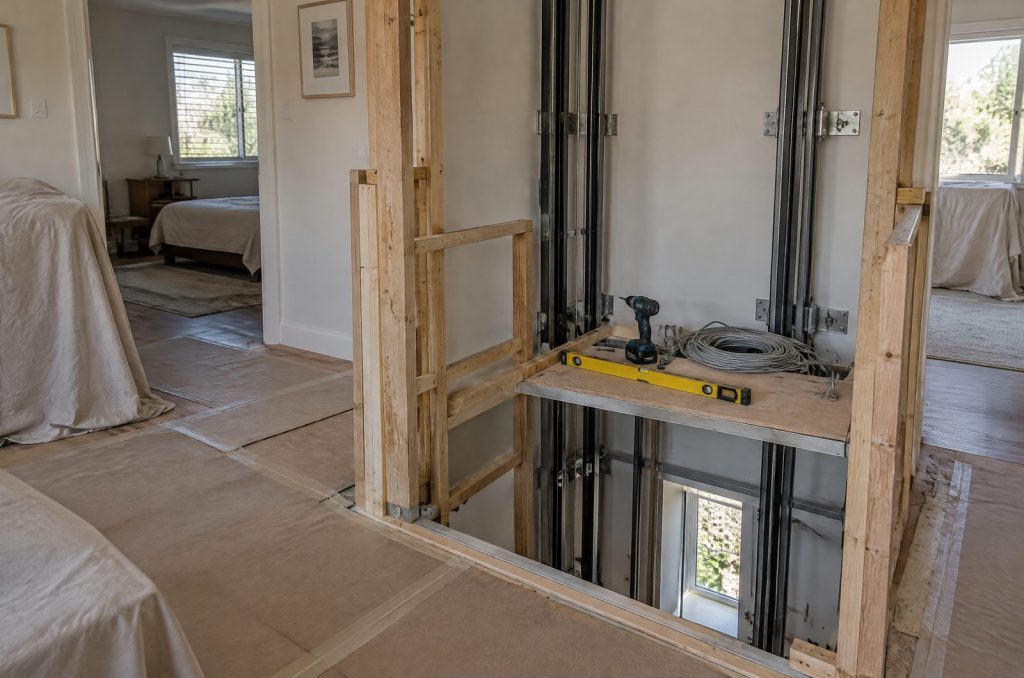
For home lifts Sydney owners are usually retrofitting, the constraint is the site, not the lift. Inner-city and inner-west terraces and semi-detached homes commonly offer side access too narrow for anything but a compact unit, and the shaft has to be built within it. Where a residential lift or home elevator goes into an existing dwelling, the structural work around the shaft usually costs more than the unit.
The second is approval. Heritage conservation areas across the inner west and lower north shore impose visual and streetscape conditions, and a lift that serves a lot inside a strata scheme touches common property, which means owners corporation consent before anything is ordered. Sloping sites on the North Shore and the Hills change the shaft solution again.
The third is specification. Home lift packages are sold on footprint and price, and the parts that matter later are the ones least discussed at the sales stage: servicing arrangements, spare parts holding, warranty terms and who attends a fault. Step-free access is what the owner is buying, and it is worth testing who delivers it at 7am on a Monday. Owners comparing compact home lifts Sydney wide should hold the same neutrality ILCPL applies to commercial plant. For the wider picture, read the home lift guide.
Sydney questions
Frequently asked questions
6 questions
Does ILCPL have a Sydney office?
No. ILCPL operates from Queensland and works nationally. Advice on a Sydney asset is delivered by the same consultants who would attend in Brisbane, and the practice states that openly because independence matters more here than a local address. Owners comparing lift consultants Sydney wide are usually comparing parties with equipment to sell.
Can ILCPL attend an owners corporation meeting in Sydney?
Yes. Committee and general meeting attendance is a normal part of the engagement, either in person or by video, and the documentation is prepared so a non-technical committee can act on it without further translation.
Who regulates lift safety in New South Wales?
SafeWork NSW. Approval of building work is a separate matter, handled by council or a private certifier under the Environmental Planning and Assessment Act.
What is the difference between an owners corporation and a body corporate?
They describe the same idea under different legislation. New South Wales uses owners corporation under the Strata Schemes Management Act. Queensland uses body corporate under the Body Corporate and Community Management Act.
Is a home lift in Sydney subject to the same rules as a commercial lift?
No, the obligations differ by class of plant and by whether the unit sits in a dwelling or in common property. Where the lift serves a lot inside a strata scheme, the owners corporation becomes involved, and that is usually the point at which a straightforward purchase becomes a project.
How early should an owner bring a consultant into a modernisation?
Before the scope is written. Once a contractor has proposed a solution, the owner is evaluating a single option rather than choosing between several, and the commercial position is already set.
Areas we cover
Other areas
Each page is written for the jurisdiction it sits in, because the framework changes at every border.
- QLD
Brisbane
The deepest project history in the practice, across towers, retail, hospitals and universities.
Brisbane lift and elevator consultants - VIC
Melbourne
High-rise residential density arriving at its first full modernisation cycle.
Melbourne lift and elevator consultants - SA
Adelaide
A public-sector-weighted market with formal procurement and community titles.
Adelaide lift and elevator consultants - ACT
Canberra
Long-held government and institutional assets with scheduled audit obligations.
Canberra lift and elevator consultants - NZ
New Zealand
Three centres on the published record, working across a longer supply chain.
Lift and elevator consultants in New Zealand

Contact
First step
Send the address, the number of lifts or escalators, the building’s age, and any current maintenance contract or recent service report. If the matter is a committee decision, include the meeting date, because the documentation is built around that deadline. ILCPL will confirm whether the next step is a review, a feasibility study or a design engagement.
0417 784 245QLD base, national delivery

Send the details and we will come back to you