

Lift and Elevator Consultants in Melbourne
Melbourne's apartment boom put a large volume of residential towers into service in a short period, and those buildings are now reaching the point where the original lift plant stops being adequate. The first full modernisation cycle is arriving across a large number of lots held under owners corporations, and the cost lands on people who did not buy the building new. ILCPL has worked owner-side for nearly 50 years, supplying no equipment and holding no maintenance contracts, on lift consultants Melbourne committees can engage without a conflict sitting in the room.
- Density, not scale a single tower can carry a bank of lifts, so one decision multiplies across the asset.
- WorkSafe Victoria and the Owners Corporations Act advice framed for the state's regulator and the owners corporation that has to resolve on it.
- Feasibility before commitment ILCPL is engaged at planning stage on Melbourne institutional assets, not only after failure.
- No equipment, no maintenance contracts no manufacturer, supplier or installer affiliation to work around.
Local context
What shapes lift and elevator work in Melbourne?

The towers are younger. The cycle is arriving. The cost is concentrated.
The first characteristic is residential density. A single apartment building can hold a large number of lots on one lift bank, and each unit contributes to a fund that has to cover a full replacement at once. The committee is managing a capital event, not a repair, and the difference shows in how the scope is written and how the whole-of-life cost is staged.
The second is the age of that stock. Towers completed through the 1990s and 2000s are entering their first modernisation with the original specification often unavailable, and with the added complication that the building is fully occupied. Hoisting, access and tenant disruption become programme constraints, and an out of service lift in a full building is a management problem before it is an engineering one.
- Third, Melbourne carries institutional and events infrastructure that is publicly scrutinised. Work on major venues is planned and documented differently to work on an office floor, because the operator needs certainty about downtime before committing.
ILCPL works owner-side on each: a capital position the committee can put to a meeting, a specification that is neutral on manufacturer, and a programme built around access rather than around a supplier’s availability. Lift consultants Melbourne committees engage often arrive after a contractor has quoted; the useful position is one formed before that quote exists.
Services
Which services are available in Melbourne?
The three lines below cover the work a Victorian owners corporation most often needs. The premise behind all three is set out in ILCPL’s consulting history: no equipment is supplied and no maintenance contract is held.
Lift consulting
Maintenance contract review, modernisation assessment, due diligence, capital planning and staged replacement advice, with the numbers set out for a committee that has to raise a levy.
independent lift consultantsElevator consulting
Traffic analysis and vertical transportation planning, shaft and overhead coordination, neutral specifications and tender evaluation. Where the engagement runs to documentation, design work is delivered through lift design.
elevator consultingEscalator consulting
Safety and condition assessment and maintenance review, including the retail and venue escalators that carry Melbourne’s public foot traffic. Detailed reporting sits in escalator safety reporting.
escalator consultants
Getting started
Finding a consultant you can rely on
Most owners corporations come to this after a levy is proposed or a quote arrives with nothing to compare it against.
- One consultant, start to finish. Not a handover between a site visit and the advice.
- Scope agreed before work starts. You know what the engagement covers and what it costs.
- Nothing to sell you. No equipment, no maintenance contract, no supplier line.
- Written for your committee. Plain enough for a general meeting, precise enough to price.
How it works
Service you can rely on
- Send what exists.The contract, recent service reports and any previous report. Nothing is booked until it has been read.
- The plant is inspected.Condition against exposure, not against a schedule, with findings recorded as they are found.
- A written position.What needs doing, what does not, what it costs, and what can be staged so the committee can stage the spend.
The record
Has ILCPL worked on projects in Melbourne?
Three engagements are attributable to Victoria on the published record. Two are feasibility studies, and are described as such.
- Victoria Point Development, Melbourne
- An apartment development lift project, covering the lift requirements of a residential development.
- Herbert Street, Melbourne
- A feasibility engagement, assessing vertical transportation requirements at planning stage so the client could test options before the design was fixed.
- Melbourne Exhibition Centre
- Feasibility work on major events infrastructure, where the operator needed an independent view of lift and escalator provision and downtime exposure.
Feasibility is not installation. The complete record, which is concentrated in Queensland, sits in the published project lists.
Compliance
What compliance rules apply in Victoria?
- Regulator
Occupational health and safety on a Victorian site sits with WorkSafe Victoria under the Occupational Health and Safety Act. Notification and incident obligations follow that Act rather than the harmonised model used in most other states.
- Approvals
Building approval runs through the Victorian Building Authority and an appointed building surveyor. The surveyor is a named party in the process, not an optional extra, and a lift project that changes the shaft or the fire compartment is documented for that appointment.
- Terminology
The owner is an owners corporation under the Owners Corporations Act. Fees, levies and the rules for raising a special resolution differ from the New South Wales scheme of the same name, and a report written for one does not automatically suit the other.
- Asset profile
High-rise residential apartments, mixed-use towers, heritage commercial buildings in the CBD and inner suburbs, retail, and major events and institutional infrastructure. That spread is why lift consultants Melbourne wide cannot be served by a single template.
These are genuinely different arrangements, and the difference is why an owner in Melbourne is served better by a page written for Victoria than by one adapted from somewhere else.
Residential
What do home lifts Melbourne owners need to resolve before ordering?
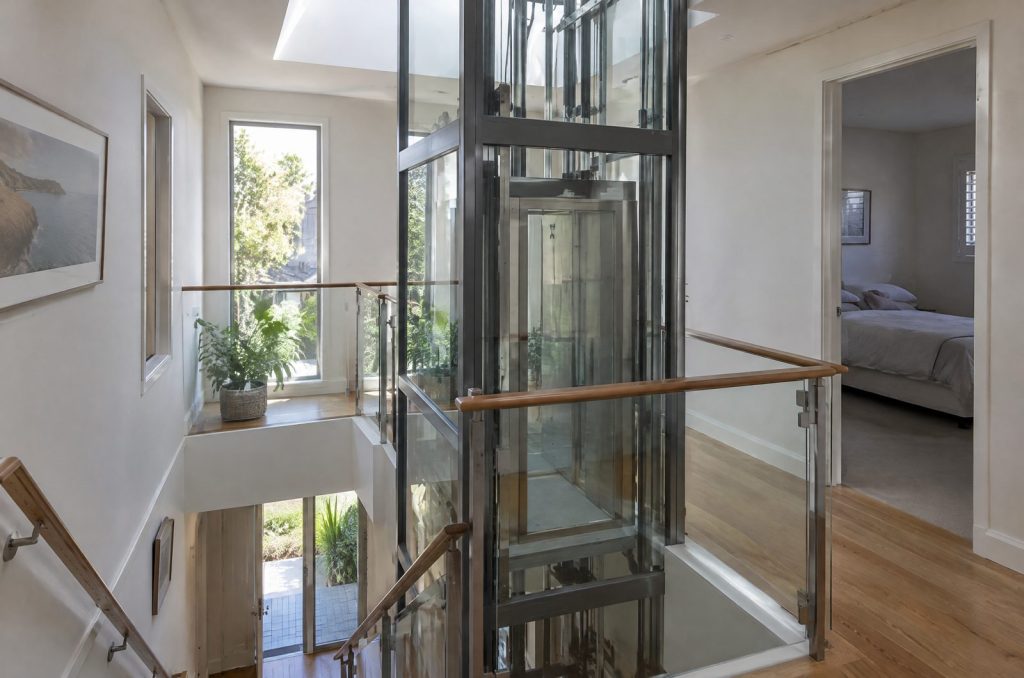
For home lifts Melbourne owners are usually retrofitting into an existing dwelling, access to the site matters before the unit itself. The inner north and inner west present narrow frontages and long, deep blocks, and rear-lane access is often the only practical route for plant and materials. In Fitzroy, Northcote or Brunswick a residential lift can mean a shaft in a hallway rather than a room built for it, and the structural solution drives the cost.
Heritage overlays cover large parts of those same suburbs, which brings permit requirements and streetscape conditions into a decision that starts as an accessibility question. Step-free access is the usual goal. Further out, in the middle and outer ring, home elevators are increasingly specified at build stage in townhouse developments, where the shaft is far cheaper to coordinate before the slab is poured than after.
Ground conditions matter here too. Parts of inner Melbourne sit on ground with a high water table, and pit depth becomes a real constraint rather than a drawing detail. Owners comparing compact home lifts Melbourne wide should test the pit and shaft assumptions, and the servicing and spare parts terms, before comparing unit prices, because those assumptions are what the price depends on. For the wider picture, read the home lift guide.
Melbourne questions
Frequently asked questions
6 questions
Does ILCPL have a Melbourne office?
No. ILCPL works from a Queensland base and delivers nationally. That is stated plainly because the value on offer is independence from manufacturers, suppliers and installers, and independence is not created by renting a desk in the same city. Owners comparing lift
consultants Melbourne wide are comparing who carries a supplier line and who does not.
Can ILCPL present to an owners corporation committee in Melbourne?
Yes. Committee and general meeting attendance is routine, and the documentation is written so that lot owners without an engineering background can follow the reasoning and vote on it.
Who appoints the building surveyor on a Victorian lift project?
The owner appoints the building surveyor, who then works within the Victorian Building Authority framework. It is a separate appointment from the lift contractor and should be treated as such.
Is a Victorian owners corporation the same as a New South Wales one?
The name is the same and the legislation is not. Victoria uses the Owners Corporations Act, New South Wales uses the Strata Schemes Management Act, and the rules for raising money and passing resolutions differ.
Our building has several lifts and the contractor says all of them need replacing. How do we test that?
With an independent condition and modernisation assessment. Age alone does not establish that plant has reached the end of its economic life, and a staged replacement is frequently the better commercial outcome.
When should a developer bring a consultant in on a residential tower?
At traffic analysis, before the core is set. Once the shaft and overhead are locked into the structure, the options narrow to whatever fits, and the cost of change rises sharply.
Areas we cover
Other areas
Each page is written for the jurisdiction it sits in, because the framework changes at every border.
- QLD
Brisbane
The deepest project history in the practice, across towers, retail, hospitals and universities.
Brisbane lift and elevator consultants - NSW
Sydney
A deep stock of ageing commercial towers, most of it held inside strata schemes.
Sydney lift and elevator consultants - SA
Adelaide
A public-sector-weighted market with formal procurement and community titles.
Adelaide lift and elevator consultants - ACT
Canberra
Long-held government and institutional assets with scheduled audit obligations.
Canberra lift and elevator consultants - NZ
New Zealand
Three centres on the published record, working across a longer supply chain.
Lift and elevator consultants in New Zealand

Contact
First step
Send the address, the building’s completion date, the number of lifts and the current maintenance arrangement. If a contractor has already proposed a replacement, include that proposal, because testing someone else’s scope is a faster route to a position than starting from nothing.
0417 784 245QLD base, national delivery

Send the details and we will come back to you