Accessible Lifts: Platform and Wheelchair Options That Actually Pass an Audit
Platform lifts often fail the access requirement they were installed to meet. Which platform and wheelchair options pass an audit, and where the gap between installation and audit opens.

- Published
In this article 7 sections
In this article
Quick summary
A platform lift is often installed to satisfy an access requirement, and then found two years later not to satisfy it. The reason is almost never the equipment. It is that the requirement was interpreted by an installer rather than by someone who understood what would be audited. This article sets out which platform lift and wheelchair lift options exist, what each one genuinely provides, and where the compliance gap usually opens.
A platform lift is a compliance decision before it is a product#
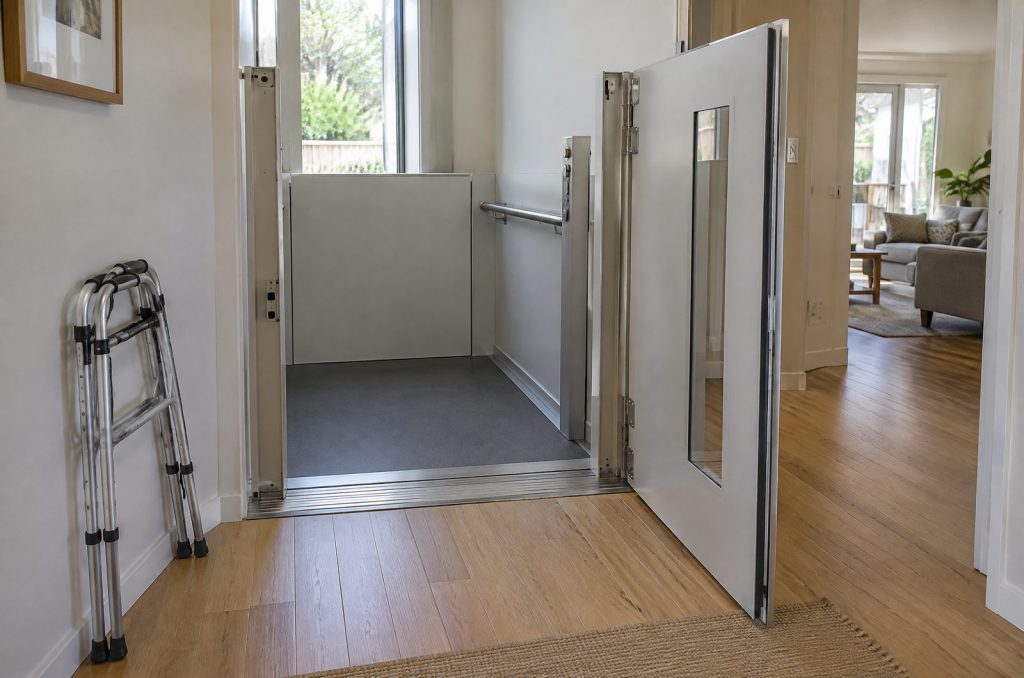
The equipment is straightforward. A platform lift moves a wheelchair user, or a person with limited mobility, through a short vertical rise. A wheelchair lift does the same job in a different configuration.
What is not straightforward is the requirement behind it. A building has to provide accessible access, and there is usually more than one way to satisfy that. A platform lift is one way. A ramp is another. A passenger lift is a third, and a relocated entrance is a fourth.
Choosing the platform lift first and the compliance route second is the single most common error in this category.
The platform lift and wheelchair lift options#
Three types of platform lift appear in Australian buildings, and the practical differences matter more than the labels.
A vertical platform lift moves straight up, in a small shaft or an enclosed structure. It is the closest thing to a small lift and it is the most common answer for a short rise inside a building.
An inclined platform lift runs along a stair flight, folding away when not in use. It suits existing buildings where a shaft cannot be built, and it suits stair geometry rather than floor plans.
A wheelchair lift is the broader category, and in a domestic setting it usually means a short-rise device for a single flight or a single level change. Our passenger lift service covers the point at which the rise becomes large enough that a platform lift stops being the sensible answer.
Where the compliance gap opens#
The gap opens in four predictable places.
Rise and travel distance. A platform lift is suited to a short rise. Above a certain rise the requirement is a passenger lift, and a platform lift installed to cover a rise it was never intended for will not satisfy the audit, however well it works.
The route, not just the device. Accessibility is assessed across the journey, not at the machine. A compliant platform lift at the end of a route that is not itself accessible fails the requirement.
Control and operation. A platform lift that requires assistance to operate is compliant in some settings and not in others. Public buildings and staffed buildings are assessed differently.
Maintenance and verification. An accessible lift has an ongoing obligation attached. The obligation is rarely documented at handover, which is why it is discovered at audit.
Platform lift options compared#
| Option | Best for | Limits | Where it fails an audit |
|---|---|---|---|
| Vertical platform lift | Short rise inside a building | Limited rise and capacity | Rise exceeds the intended range |
| Inclined platform lift | Existing stairs, no shaft possible | Stair geometry, fold-away operation | The stair itself is not compliant |
| Wheelchair lift | Single level change, domestic or small commercial | Very short travel | Used to cover a rise beyond its type |
| Passenger lift | Anything beyond a short rise | Cost, shaft, structure | Not applicable, this is the compliant baseline |
The pattern is consistent. The platform lift is the right answer inside a defined range, and the failures all happen at the edges of that range.
What drives the cost of a platform lift#
The device is a minority of the cost, and the building work is the rest.
A vertical platform lift needs a shaft, an enclosure, a pit and headroom, all of which are building costs. An inclined platform lift avoids the shaft and inherits the stair, which means the stair has to be suitable and the fold-away operation has to be acceptable to the building. A wheelchair lift is the cheapest of the three and the most limited.
The variable that catches owners is the retrofit. A platform lift designed into a building is a modest project. The same platform lift retrofitted into a finished floor is a structural and fire-sealing project with a device attached.
Our elevator improvements service deals with that retrofit case specifically, and the refurbishment projects on this site show what the work actually looks like in occupied buildings.
What to settle before you specify a platform lift#
- What is the rise, exactly, and is it within the range for a platform lift.
- What is the full accessible route, not just the device location.
- Is the building public, staffed, or private, because the requirement changes.
- Can a shaft be built, or is an inclined unit the only option.
- Who operates it, and does that affect compliance.
- What is the ongoing verification obligation and who holds it.
Why this is worth testing independently#
A platform lift is a small item on a large project, and small items get delegated.
The problem is that this particular small item carries a compliance obligation that survives the project. An installer is qualified to install a platform lift. They are not positioned to tell you whether a platform lift was the right answer for that route, and they have no reason to raise it.
Independent review here is not about the equipment cost. It is about the audit that happens after everyone has left. Our lift safety audits and reports service covers that verification, and the university and education projects on this site show how access obligations play out across large, complex campuses.
ILCPL provides independent lift, elevator and escalator consulting across Australia, New Zealand and Asia, with no ties to any manufacturer or contractor. Call 0417 784 245.